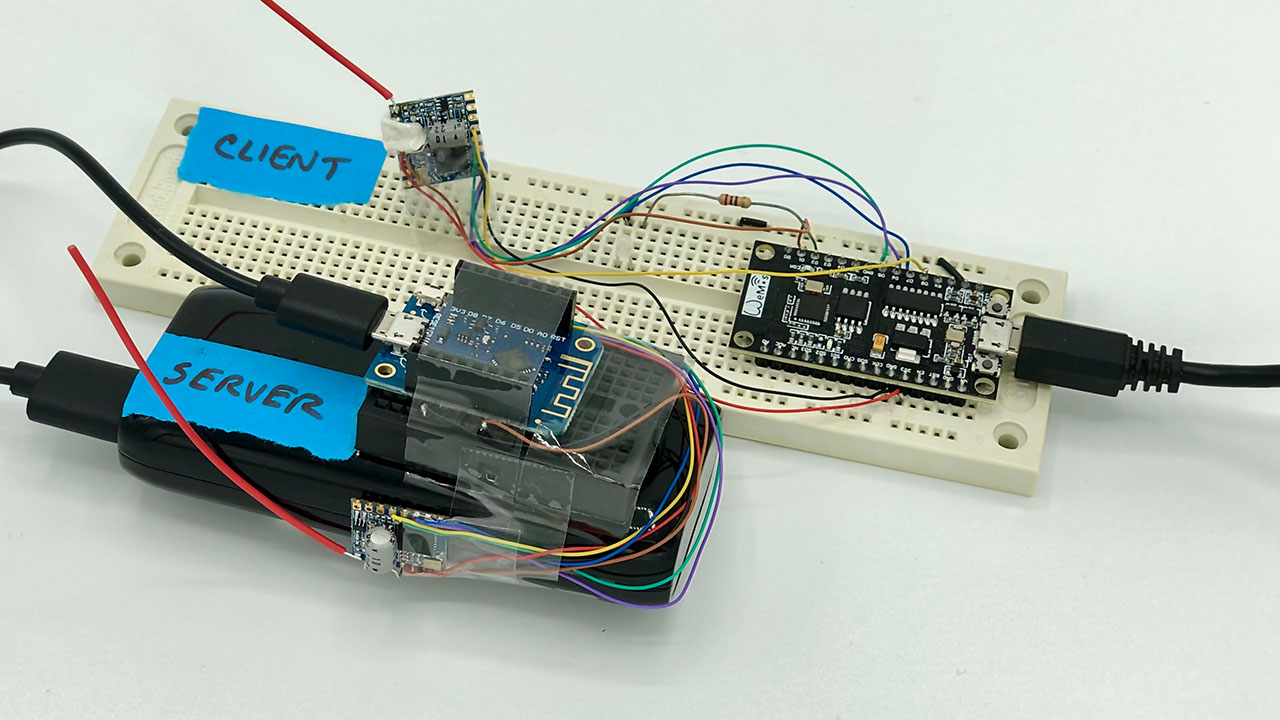
In continuation of my work with the nRF24 IoT Sensor Network, I decided to test a couple of RFM95 (LoRa) modules I had in my lab. This time, instead of using the MySensors library, I opted for a more lightweight library called RadioHead for Arduino. The objective was to evaluate the range of these LoRa modules for low power IoT applications using a simplified approach with minimal code.
Each person will only have what they endeavored towards, and that their endeavors will be seen, then they will be fully rewarded. And to your Lord is the ultimate return.
Quran 53:39-42
Testing and Results
The working prototype, which took over a week to complete, is now finished. Before finalizing the prototype, I conducted a series of rigorous tests to assess the performance of the RFM95 (LoRa) modules. I tested various configurations and environmental conditions to determine the optimal settings for range and reliability. The tests involved measuring signal strength and quality over different distances and through various obstacles.
Why ATmega328?
This low power IoT prototype forms the foundational backbone of my upcoming smart home products, utilizing an ATmega328PB and SX1276 LoRa module. I selected the ATmega328PB microcontroller for its low power consumption and robust performance. It efficiently handles various tasks while consuming minimal energy. Coupled with the SX1276 LoRa module, which provides long-range communication capabilities with low power requirements, this combination creates an optimal solution for IoT applications that require both efficiency and range. The SX1276 maintains reliable communication over extended distances, making it ideal for remote sensors and devices.
Power Consumption
Remarkably, the entire circuit consumes less than 1µA during sleep mode. The power consumption of less than 1µA during sleep mode is a significant achievement in optimizing the IoT device’s efficiency. We achieved this low power usage through careful design and component selection, which ensures the device remains operational for extended periods without frequent battery replacements. Compared to traditional IoT devices, which often consume several microamperes, this design represents a substantial improvement, extending the operational life of the sensor and reducing maintenance needs.
Unbelievable, isn’t it? Additionally, the device operates with a coin cell battery, maintaining functionality from a full 3.2V down to as low as 2.0V. With this efficient power consumption, I anticipate that a typical door sensor will last for several years.
Handmade Prototype
Update from October 14, 2020: I refined the setup by creating a handmade working prototype to test further while waiting for the actual PCB from JLCPCB to arrive.
Low Power IoT Board Schematic

Professional PCB Design – ARLO v0.1
This is my first attempt at designing a professional-looking PCB (different from the prototype shown in the video; I’m referring to the one ordered from JLCPCB). It took me around a day to design it, and it is currently in production as I write this article.

Insights and Future Improvements
Throughout this project, I gained valuable insights into optimizing low power IoT devices. One key takeaway was the importance of balancing performance with power consumption. Future improvements could include integrating additional sensors or enhancing the software to support more advanced features while maintaining low power usage. Additionally, exploring alternative power sources, such as energy harvesting techniques, could further extend the device’s operational life.
Published on 25th Safar, 1442 AH at Brooklyn, NY.

Leave a Reply